Tampilkan postingan dengan label Venture Capital. Tampilkan semua postingan

Kamis, 12 Desember 2013

14 Ideas to Make Newspace Accelerators Better

Business accelerators in Silicon Valley (CA), Boulder (CO), and across the US have been gathering the best young entrepreneurs, providing them the time, resources, and business connections necessary to start successful software companies.  These accelerators have helped such success stories as AirBNB: now worth $2.5B and DropBox: now worth $8B

Can the lessons from software-focused business accelerators be modified to benefit commercial aerospace firms (referred to here as “Newspace”) that need to develop physical hardware (not just software) with correspondingly longer product development cycles?  Are hardware-based accelerators possible?  If possible, what would these accelerators look like?  Below is an overview what accelerators are and my fourteen recommendations for enhancing the capabilities of Newspace accelerators.

For many, YCombinator wrote the definition of what an accelerator is.  Located in the Silicon Valley, YCombinator helps software startups succeed.  Twice per year they bring in a bunch of startups (from thousands of applicants) and invest in each firm ($20K for 3-7%).  In the early days, only a few firms were funded, recent batches have included over sixty startups in a single batch.  Over the course of three months (the length of the “batch”), YCombinator helps startups mature.  Some firms need help with an idea for a product, others with introductions (access to the YCombinator Rolodex), still others need help navigating the pitfalls of a growing software startup. 

Each batch culminates in Demo Day where each startup pitches to venture capitalists (and occasionally, Ashton Kutcher).  Both Air BNB and DropBox (mentioned above) were accelerated via YCombinator.  Many of the companies in each YCombinator batch…FAIL.  But the YCombinator assumes this failure will happen.  The compensation from wildly successful firms more than compensates YCombinator for the cost of the failed companies.  Since YCombinator does not know who will be successful at the outset, if the entrepreneur team is accepted into the YCombinator program…they get funded. 
YCombinator combines:
  • an “accelerator” (the advice and maturing services) with
  • a “startfund” (the capital that gets invested in each firm). 

For simplicity, I will use “Accelerator” generically throughout this post to mean the combination of both advice and capital.

Is a startup - a startup regardless of industry?  Sadly, no.  Although the YCombinator/Techstars accelerator model can serve as a template, important work still needs to be done to modify the software accelerator model to better fit hardware startups, particularly Newspace hardware startups.  The table below highlights a few of those differences:


Organizations have already begun the good work of porting the software accelerator model over to Newspace hardware startups.  Two examples include: Silicon Valley SpaceCenter and Space Tango.

Silicon Valley Space Center is a Newspace accelerator in the heart of software country (Sean Casey, Managing Director).  They provide frequent events (Hackathons) and networking opportunities.  But although SVSC makes introductions to angel capital, they lack a startfund of their own.  Space Tango is a more serious attempt to mirror YCombinator.  Space Tango has three month “batches” where participants relocate to Kentucky for a 12-week training program.  Space Tango has a startfund ($20K for 5% equity), with follow-on rounds possible.  Space Tango offers mentoring and accelerator services, but is a young organization, having only raised a $100K startfund to date.  The announcement of Space Tango’s initial batch should be made in the next few weeks.  

Below are a few recommendations for ways to build on these efforts.  My recommendations are influenced by:

I posit that Newspace ventures succeed faster with four accelerants:
  1. Low Capital to Start
  2. Speed to Market
  3. Capital and Liquidity Opportunities
  4. Industry Awareness

1.  Low Capital to Start.  Reducing the Capital requirements necessary to successfully fund a Newspace startup is a goal that both focuses the mind of Newspace entrepreneurs and focuses the efforts of support organizations like business accelerators.  For most entrepreneurs, proposing the business plan that requires hundreds of millions of dollars to execute and needs only one starry-eyed billionaire to agree is NOT a good recipe for repeatable success.  Even when the entrepreneur proposes a manageable business concept, accelerators add value by reducing costs for infrastructure services (e.g. office space, etc.) or access to capabilities that startup would normally not be able to afford (e.g. vacuum chamber for testing prototypes).  YCombinator has brokered a deal with Comcast to provide each startup extremely fast internet connection for their three-month stay in Silicon Valley.  What are the services from which a Newspace startup would most benefit?

2.  Speed to Market.  Minimal Viable Product (MVP) is a term common in software startups thanks to the work of Steve Blank and Eric Ries.  Like the name suggests, MVP’s push a startup to get a product into the hands of customers as soon as possible.  The MVP joke is if you’re not embarrassed by your MVP, your MVP is too mature.  MVP’s give entrepreneur early revenue and, more importantly, they give startups feedback from customers.  Although you don’t hear pharmaceutical entrepreneurs or nuclear power plant startups talking about MVP’s very often, the advent of Cubesats, NanoRacks-based ISS applications, and greater use of Commercial Off-The-Shelf (COTS) technology on space projects enable the MVP concept to be added to the Newspace startup lexicon.  Two-year projects are preferred to five-year projects.  Are their ways the startup can commercialize a subcomponent of their “Two-Year Project” and get to market in one year?  As a general rule, faster to market is preferable.  Note that faster to market will reduce capital requirements also (linking #1 and #2).

3.  Capital and Liquidity Opportunities.  How do we get Angel investors in an industry?  Altius’ Jon Goff said something profound in a Thruster issue about a year ago that has stuck with me.  In other industries like tech, a good-sized portion of the industry’s Angels are created from successfully exiting entrepreneurs that now have experience and capital and still want to be involved in the industry.  However these successful entrepreneurs are not ready for the hard work of starting a second startup.  The profound part of Mr. Goff’s article is acknowledging how few exits Newspace has to its credit – thus the number of industry Angels may also be reduced compared to other industries.  While industry loyalists wait for the Angels to arrive, an accelerator could be very helpful here, introducing Angels from other industries to Newspace.  This work would supplement the good work the Newspace Global and many others are already working in this arena.  As discussed above, YCombinator not only offers capital from their startfund, but also brokers countless introductions between startup and capital sources.  With each introduction, YCombinator’s capital rolodex grows.  With each successful startup to graduate the program, YCombinator’s alumni network grows as well.  Both are important.

4.  Industry Awareness.  Newspace, focused on commercial aerospace projects, would greatly benefit from a higher industry profile.  Many still are unaware of the unshackling from Government contracts that is underway within the aerospace industry.  Accelerators can help significantly here.  By aggregating Newspace startups into a single effort, accelerators may be more influential to news organizations and those peaking over the fence into Newspace from the outside.  In the same way #1 and #2 are linked.  Note how #3 (capital and liquidity) are linked to #4 (industry awareness).

Here are Fourteen Ideas for enhancing a Newspace hardware accelerator:
  1. Makerspace (free tools, supplies, and office space) run by the Accelerator.  Because the cost and time to develop a prototype, aerospace firms have a tendency to develop elaborate PowerPoint files, predisposed to take contract money before engaging in any significant prototyping.  And when the industry does build, they over engineer since “this has to work” and often the project lacks prior iterations to leverage.  Chris Anderson, in his book, Makers: The New Industrial Revolution  illustrates how accessible manufacturing technologies are to the average person.  Jon Goff reinforced this point when describing the makerspace Altius uses in Denver and the 3-D Printer they use in the office.  Make these tools available to startups within your Accelerator.  I envision a facility that combines co-working space with a common makerspace area to access shared tools for R&D manufacturing.  What would you do if a laser cutter were as accessible as PowerPoint?  The ethos of the startup changes from talking to doing, from PowerPoint to building hardware.
  2. Small product/service.  Accelerator advisors should HIGHLY encourage their teams to think smaller.  Less to develop – reduced capital requirements - faster to market – probably faster to exit.  I like the story Jon Goff tells. He wanted to develop an orbital propellant depot (gas station in space) so he focused on tugs which could be a major component of depots (depending on the architecture) and could be developed much less expensively than a depot.  But tugs were still too big, too expensive for a startup develop, so Jon evaluated what elements of a tug he could make better.  Believing rendezvous and docking technology was ripe for disruption, Altius invented Sticky Boom. 
    Accelerator startups should be asking the same “downsizing” questions.  
  3. Greybeard Mentor/Labor Team.  Unlike software startups where a coder could be one of the world’s best before age 25, it takes time to develop as an aerospace engineer.  And the aerospace engineers with real-world experience are highly prized.  Under most scenarios, this type of experience is not available to Newspace startups.  Accelerators could offer each batch access to a team of semi-retired “Greybeards” – engineers with hardware roving on Mars or orbiting Jupiter.  Greybeards could review/critique plans by joining a firm’s advisory board or even play a more active role on startups that interest them.
  4. Partnership with local universities provide low cost graduate work force.  Another cost-saving method would be to offer the batch access to competent part-time workforce to help move the MVP to Demo Day.  I am not necessarily saying these same students would build the flight hardware that flies on the International Space Station (although some could).  I am saying that free competent labor can help enhance a startup’s product offering by Demo Day.  Good for the student.  Good for the entrepreneur.
  5. Shared Admin Services.  Using my Makerspace/co-working space as a model, batch-mates could share the cost of an administrative assistant.  Jon Goff laments the number of hours he spent, in the early days of Altius Space Machines, doing “non-CEO activities.”  They had to be done and there was no one else to do them.  An admin assistant could help alleviate this problem and make Accelerator-empowered CEOs all the more productive.
  6. ZeroG Partnership – free/discounted parabolic flights.  If YCombinator gives Comcast Business-class internet service to their batch-lings, then a Newspace accelerator could offer services like those listed below to help Newspace startups: (1) Suborbital Partnerships (Armadillo, Masten, etc) – free/discounted suborbital flights (2)NanoRacks Partnerships – free/discounted ISS flights (3) Access to major aerospace testing facilities (Boeing, a major university, etc.) (4) Low cost business solutions offered at a discount – even Newspace startups would like to have Comcast Business internet.
  7. ITAR Lawyer services FREE.  Worth mentioning here, unlike most software startups, Newspace startups need to be aware of International Traffic in Arms Regulations (ITAR) and develop strategies to not run afoul with the State Department.  Many of these startups would benefit from lawyer services to help navigate the ITAR swamp.  An Accelerator can help facilitate this.
  8. Market Analysis and Biz Model Development Support (Newspace Analytics, Newspace Global, etc.).  Another service that would help young startups would be assistance in developing a business model with profit potential.  Firms like Newspace Analytics and Newspace Global or accelerator in-house services would be very valuable to the entrepreneur.
  9. Lessons from Clean Tech.  In preparing this post, I interviewed Interview Jeff Lints, Director of Operations, of the Energy Fellows Institute.  The Energy Fellows Institute looks to bring accomplished C-Suite executives or second-time entrepreneurs from other industries into Clean Tech.  Recognizing the challenge in attracting the best and brightest innovators to clean tech, the Energy Fellows are influencing the quality of the entrepreneurs in their industry through a similar accelerator-type program.  Newspace shares many of the same challenges to Clean Tech.  Newspace entrepreneurs may value greater participation from accomplished C-Suite executives and successful second-time entrepreneurs.  Imagine preparing for Newspace Demo Day where the entrepreneur is not only trying to woo potential investors but is also interested in attracting a COO/CFO/CEO from a stable of qualified candidates.  These C-Suite candidates have been watching each firm in the batch throughout the term.  Convincing one of them would, not only help your startup make better decisions, but also help close on the next round of funding.
  10. $200K up-front investment.  In the early days of YCombinator, they traded ~$20K for 3-7% equity.  Recently, they have increased their funding levels via a convertible note.  Space Tango is also talking $20K of capital offered to each startup (although Space Tango has hinted at the possibility of follow-on financing for those Newspace startups with promise).  So what is the appropriate capitalization level to enable startups to develop/test real products?  Jon Goff helped considerably here.  Mr. Goff recommended $200K for each startup.  This would cover early hardware R&D work and labor costs (the two largest expenses for early hardware startups) at least through Demo Day.  The $20K offered by several current accelerators is too small, if the intend of the capital was to truly produce a near-term MVP.
  11. Six-month Batches.  Both YCombinator and Space Tango offer an intense 3-month on campus experience for their batches.  A six-month cycle acknowledges that hardware takes longer to create then software code.  The six month batch also gives time to schedule testing via zero-g, suborbital flights, and local universities and large aerospace firms.  Such testing would be much more difficult to include if the program only lasted 3 months.
  12. Demo Day.  Without the lure and threat of a room of VC’s/Angels waiting for each startup’s presentation at the end of the batch, startups within the accelerator lose a strong forcing function.    A Newspace accelerator should put special emphasis here – the accelerator’s value to each startup will be heavily impacted by the quality of VC’s and Angels the accelerator can attract to Demo Day.  For most startups within the program – every decision should be made with Demo Day in mind.
  13. Newspace Accelerator for a better Newspace industry.  Although not required to be an accelerator, using the accelerator to promote the industry as a whole is strong way to grow the pie.
  14. TV Documentary/Reality Show for each batch.  Again, not required.  But with the success of ABC’s Shark Tank there appears to be an appetite for shows about entrepreneurs striving to make to succeed in business against all odds.  This may be one area where Newspace actually has an advantage over Silicon Valley and YCombinator.  Watching a startup team operate an welder, see a 3-D printer manufacturing parts and watch real hardware get tested on a suborbital rocket flight is much more satisfying television than overseeing a twenty year-old writing code in his apartment while eating Raman noodles and drinking Red Bull.
These ideas are expensive.  If an Accelerator offered $200K to five ventures per batch, that is $1M per year in equity capital investment.  Plus another $1M in operational costs to maintain the makerspace/co-working space, staff salaries, testing assistance for startups, etc.  $2M in annual obligations may be challenging to achieve.  However, an underfunded Accelerator loses much of its value and thus loses much of its appeal.

*********
Dream with me.  After months of interviews and intense deliberations, SpaceCombinatorselected its latest batch of Newspace startups.  Co-locating to Boulder, CO was an issue for some, but in the end the value of the six-month program, the access to all of the major aerospace firms along the corridor to Denver (and the occasional trip to the mountains) made the co-locating rule manageable.  $200K for 15% equity stake gave each selected firm an immediate $1.3M valuation.  SpaceCombinator chose the majority of firms for their ideas, but a few firms were selected because the selection committee was impressed with the founders (even while the product idea needed to be rethought).  Over the six-month batch, the firms worked with staff to develop products customers will buy.  A few firms switched products after R&D efforts indicated a needed pivot.  

SpaceCombinator provided a steady stream of guest speakers from both small and large aerospace firms at the weekly dinners.  NASA spoke one night.  DFJ’s Jurvetson spoke one night.  The in-house makerspace enabled a quick validation of design assumptions, and made conversations with customers more productive with tangible prototypes to discuss.  The teams were constantly iterating (iteration has always been the best type of failure).  Hardware tests were conducted via partnerships with the big aerospace firms.  One firm even flew suborbitally (twice).  Another batch-mate is on the manifest for an upcoming NanoRacks flight to the ISS.  SpaceCombinator’s alumni list is growing.  With a handful of successful exits and several dozen going concerns, alumni firms share a special bond with the current batch and look for ways to help these startups in the same way they were helped by even earlier batches.  Greybeards, SpaceCombinator’s group of seasoned veterans, taught several founders to weld, helped two startups understand the complexity of ISS-based deployments and introduced at least one firm to those within NASA’s ISS-utilization office.  The separate group of C-Suite executive veterans made the rounds to each of the startups.  They gave advice, asked questions, listened to Pre-Demo Day pitches.  One exec did not wait for Demo Day, she accepted an offer to join one of the firms as CEO.  The firm’s founder was only too willing to move to the CTO role to make room for the more accomplished CEO.  An unforeseen benefit has been the amount of cross-fertilization of ideas and methods that has come from co-locating the startups at the makerspace.  Teams come out of their offices to see what their batch-mates are working on.  All are motivated to build more and do more when others are watching.


And it all culminated in Demo Day.  NASA, Angels, VC’s, Lockheed Martin, Boeing, Northrop Grumman, Ball, NanoRacks, and others were all there.  Each firm in the batch took turns sharing slides and demoing hardware.  One firm had only that – a vision and limited HW model to show for their six month effort.  But several had strong stories of flight-demonstrated hardware, paying customers, and a plan for growth and profits.  One firm could already announce true revenue with presales from an upcoming commercial rocket flight.  SpaceCombinator took the concepts pioneered by software accelerator and made them work for hardware startups going to space.

Kamis, 20 Oktober 2011

Investing in Virgin Galactic

Abu Dhabi’s Aabar made a second investment in Virgin Galactic in July, increasing its stake in the company to roughly one-third ownership.  This marks the second investment by the Abu Dhabi based fund in the last three years. 

Bottom line:
  • 2009 investment for $280M equaled a 31.8% stake.  Post Money valuation of $900M.
  • 2011 investment for $110M increased its ownership stake to 37.8%.

Based on this data I estimate one of two scenarios:

Scenario #1: The 2009 investment was a down round with prices per share less than what Virgin had previously valued the company, and the 2011 was an up round.  An example of this scenario is provided below.  Note the percentage change between share price is valid but the share price itself is not publicly known, so I am using a simplified $1 per share for example purposes.


Scenario #2: The share price has not changed since the company's founding.  In addition to the two Aabar investments Virgin has brought in $21.5M from other outside investors.  An example of this math is below.


Both of these scenarios match the data provided by Aabar for the last three years. 

Reasons for Virgin taking additional investment range from:
1.       Preparations for new growth (Nanosat Launch vehicles or other new products)
2.       Paying for the delays in reaching commercial operations for its suborbital product
3.       Building up a war chest for a rainy day (when money is available sometimes you just take it)

Selasa, 16 Agustus 2011

Does your Mom Understand your Business Plan?


Several months ago Jonathan Goff, CEO at Altius Space Machines, called me.  ASM was preparing for a business plan “sprint” to compete in the 2011 Heinlein Business Plan competition in Silicon Valley (hosted by the Space Frontier Foundation).  Could I help with the business stuff?

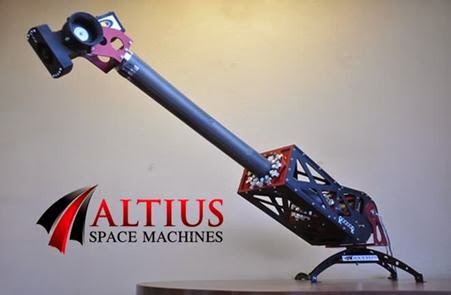
Jon had been pitching his new technology – “Sticky Boom” which is a really long tube with glue pads on the end of it.  Only the tube can be rolled in or out and the glue can be turned on or off via an electric current.  Altius knew Sticky Boom had space rendezvous and docking applications (think servicing satellite, grabbing lost wrenches during EVAs, etc.), but could we wrap a business around this cool technology?

Assisting on the Altius Business plan has been a big part of my life over the last few months which is my excuse for light blogging.  

I am pleased with the result (yes, we won the $25K grand prize).  Here is Jon Goff, Altius's CEO, pitching the plan (worth watching to get a better feel for what ASM is really trying to do as a company - about 6 minutes long).

Here are a few highlights the team at Altius and I kept discussing while developing this plan:
  • Is there a problem people will pay you to solve?  If not, you do not have a market.

  •  An attractive Market is even more valuable than an attractive technology.  New space technology is cool to us space nerds, but markets determine how valuable company technology really is.

  • Your customer is the organization that pays you – not necessarily the group that uses your product.

  • Once you have found a market, be cautious before competing head to head with incumbents (those competitors already selling to your market) – how do you take market share away at the edges without drawing an incumbent response – a disruptive strategy .

  • Management team – do you have the right team?  This is so important.  If you get the market and management right (and maybe a little traction), investors know that even if the product or technology changes over time, the company will have a good chance at success.  There is no substitute for the right market and the right team.

  • Money: how much do you need and how are you going to get it?  Banks probably won’t lend to you (at least not at first).  Investor money is an obvious choice but have you thought about govt contracting or strategic partnerships?

  • Few investors understand NewSpace (if you find one that does, keep him/her happy!).  The industry is small and in its infancy.  It is not right to expect Tech and Biotech investors to immediately understand: ISS regulations, LEO vs GEO, terminator tethers, plane changes, lagrange points, etc.  The question becomes how to present your idea in terms/images VC’s will understand while still being concise?  I recommend pitching your deck to your spouse or your mom.  If your Mom doesn’t understand your plan, VC’s won’t take the time to understand it either.  Simplify.  Simplify.  Simplify.

  • The “prize” in most public competitions is the publicity and connections made as a result of winning, not in a the few dollars at stake.  This is what the Google X-Prize teams are fighting over – the media rights!  To highlight the value of publicity, here are a few of the Altius Space Machines articles that have been written since winning the prize.  Ask yourself how long it would have taken to generate this media attention without the win?

List of articles:

  1. Aviation Week

  2. CNBC

  3. The Space Review

  4. Business News Daily

  5. Plus the sites that published the press release or the many posts by NewSpace blogs (thanks guys).

Business plans are like going to College – professors push you to do what you probably could not discipline yourself to do on your own.  This is why we have all-nighters finishing 20-page papers and cramming for tests.  On your own, you would just go to bed.

Business plans are great forcing functions and entrepreneurs learn a lot through the process.  I am glad I got to be apart this journey.

Here was some great advise we tried to follow when preparing the slide deck for the competition:

Kamis, 10 Maret 2011

Time to Raise Money for a Space Startup?

Lately, I have been getting questions from space entrepreneurs about a thawing Angel/Venture market and what that means for New Space firms seeking investment capital. Mark Suster over at Both Sides of the Table wrote a great post on:

8 Questions to Help Decide if You Should be Raising Money Now.

 Below are Mark’s eight questions with my commentary intermixed. Note, Mark is a Silicon Valley investor so many of his examples are focused in that area – still a lot to glean for New Space.


1. Are you in the “lean” phase?

Are you trying to figure out if your idea is an incremental improvement or a game-changer – if so, keep your capital needs small. Once you have proven (even if just to yourself) the world-changing worthiness of your idea than gather some investment money and ramp up capital use. When seeking seed funding – usually look for $500K to $1M initially from outside investors.

2. How much capital do I need to run my business effectively right now?

A good rule of thumb: an entrepreneur needs capital for 18 months of operations. I appreciated this nugget. As an entrepreneur, eighteen months feels like an eternity, but I should be striving for this!

3. How much dilution am I going to have to take now?

Expect 25-33% dilution per round. What does this mean? Each round your percentage ownership will be “diluted” as investors take a share of the value of the company. Here is a quick example:

An investor offers The founder of Acme Rockets a pre-money valuation of $2M for a $1M investment in Acme Rockets. Should Acme Rockets agree? Before the investment Acme Rockets owned 100% of company. If they accept the investment terms, the Acme Rockets founder’s ownership percentage will be diluted to 67%, a 33 percentage point reduction. Worth it? Maybe.


How about a $2M investment at $2M pre-money? 50% dilution in a single round. Probably not.


4. How many more rounds of capital will I need & what is my expected total future dilution?


Here is the spreadsheet (containing the table above) where I provide an interactive example of Founder Dilution with each Round of additional Investment (overly simplistic to make the point).  Fun to play with.

5. What things could I do with capital today that might improve my market positioning?

I hear the argument which goes – wait to raise capital until you can get a more favorable valuation. For New Space companies like Acme Rockets, this means winning government contracts, building demos, increasing customers for an NLV upper stage which is not yet built – anything to mature their technology.

But there is an opportunity cost in waiting. What could Acme Rockets do now with $1M dollars to grow their company? This is “make-the-pie-bigger-and-don’t-care-so-much-about-your-slice-of-it” argument.

6. What things might competitors do if I don’t raise capital that might impact me in the interim period?

The biggest nugget in this section was the psychological effect investors feel if another firm in an industry announces a large funding round. Who wants to invest in NLV upper stages from Acme Rockets after its competitor just took the oxygen out of the room by announcing a $10M investment to build a similar NLV upper stage? Raise capital so your competitor can’t – I agree with this in the short term, but I would rather focus on wowing customers than fearing competitors.

7. What might future markets hold in terms of valuations?

Try raising money right after September 11, 2001. When is the next market dip?

8. What might future markets hold in terms of ability to raise capital?

Mark ends by reminding us that 8 Questions to ask are nice, but don’t over think this, sometimes you take the deal because the money is available…and might not be tomorrow.

Thanks Mark for a great 8-Question post. Worth reading it in Mark's words over at Both Sides of the Table.  Space Entrepreneurs, I hope it helps.

Rabu, 09 Februari 2011

New Venture Capital for New Space?

Last week the White House began a push aimed at assisting entrepreneurs in high-growth industries. The Startup America Partnership seeks to connect entrepreneurs with the capital and expertise of large corporate/non-profit organizations - taking what works and doing more of it.

“Our nation once again looks to these creative risk-takers to unleash the next wave of American innovation.”
Bureaucracy tends to favor the large (I hate the phrase, “too big to fail”).  So it is nice to see this focus on the entrepreneur.  Over 24 firms have joined the President in committing dollars or expertise to the Startup America Partnership:
  • Intel contributed $200M (over which period of time?)
  • IBM contributed $150M for 2011
  • HP contributed $4M for 2011 (come on HP, you can do better!)
  • Facebook is sponsoring gatherings for startups (part VC pitch/part mentorship)
  • The Kauffman Foundation and AOL’s founder, Steve Case, have joined forces to help lead the Startup America Partnership (in college I worked closely with the Kauffman Foundation through an organization called SIFE – they are good people doing good things)
I know Fred Wilson and other Tech Venture Capitalists are excited about this initiative from the President, but New Space should push to access these funds and expertise as well.  Maybe I missed it, but I have not seen much New Space blog traffic about the President's announcment.  Yesterday, Chuck Black spoke about the growth of the Venture Capital within NewSpace. Capital does not fix all problems within New Space, but access to more capital will surely help the industry grow faster.

Through the Startup America Partnership, the President is targeting high growth businesses/industries. The Futron Corporation reported last week, commercial space is growing at 10% per year – 10% is high growth for an industry!

The Startup Partnership is focusing on:
  • Acceleration of Scale: turning small companies and products into big
  • Education: C Suite experience for free or at a discount
  • Commercialization: working with universities to turn their innovations into products
I hope to see New Space firms in need of capital/expertise taking advantage of the opportunity. New Space is definitely a part of the Nation’s “solution for the future”.

Here is a one minute video from Steve Case introducing the Startup America Partnership:

Jumat, 26 November 2010

When It’s Darkest Men See the Stars

"When It’s Darkest Men See the Stars."  ~Ralph Waldo Emerson

Steve Blank is optimistic entrepreneurs have created the, "dawn of a new era for a new American economy built on entrepreneurship and innovation."  His excellent post focuses on why startups have fundamentally changed and are changing the business landscape by serving as the process incubator for the business world. 

Although Steve uses Silicon Valley for his examples, New Space can learn from and be encouraged by his perspective.  Read Steve's post for some rational optimism and insight on the coming decade of the entrepreneur.  I especially like this (long) quote from Steve (emphasis mine):
When James Watt started the industrial revolution with the steam engine in 1775 no one said, “This is the day everything changes.” When Karl Benz drove around Mannheim in 1885, no one said, “There will be 500 million of these driving around in a century.” And certainly in 1958 when Noyce and Kilby invented the integrated circuit, the idea of a quintillion (10 to the 18th) transistors being produced each year seemed ludicrous. 
Yet it’s possible that we’ll look back to this decade as the beginning of our own revolution. We may remember this as the time when scientific discoveries and technological breakthroughs were integrated into the fabric of society faster than they had ever been before. When the speed of how businesses operated changed forever. As the time when we reinvented the American economy and our Gross Domestic Product began to take off and the U.S. and the world reached a level of wealth never seen before.
It may be the dawn of a new era for a new American economy built on entrepreneurship and innovation.  One that our children will look back on and marvel that when it was the darkest, we saw the stars.

Senin, 26 Juli 2010

5 out of 100 - Deal with It!

If you invested in 100 start-up companies, how many would you expect to be “winners”?  A recent study by Right Side Capital Management consolidated seven recent Angel Investment reports to ask that very question. RSCM's consolidation shows interesting trends:
  • Only 5-10% of a portfolio’s investments provided the majority of the returns (most of the remaining firms were a total loss) – 5% winners/95% losers.
  • Average IRR (Internal Rate of Return) was 27% across the portfolios (in spite of the fact 95% of companies within the portfolio were losers)
  • Portfolio size: at least 100 investments to mitigate risk.
What about space firms? So if you were managing a Space Angel Fund, could you find 100 quality space firms in which to invest? In an earlier post, I encouraged young space firms to develop their companies less like defense contractors and more like Silicon Valley startups by establishing separate companies for each product/service.

For example, New Space Ventures (NSV) invested $$ millions in their micro-launch vehicle system and a year ago also started work on low-cost TPS solutions. With the micro launcher now complete and flying successfully, NSV has attracted several interested buyers for the technology. NSV partitioned the firm into two separate companies, one continuing to pursue micro launch vehicles and one investing in TPS solutions. NSV eventually sold one company and used the proceeds to fund TPS research with additional cash in reserve.

This multi-company approach will grow investment/liquidity opportunities in the industry, but is such an approach really feasible for firms so heavily influenced by their contracting cousins?

Attractiveness:
  • Liquidity events generate cash for the business selling allowing them to reinvest in future projects (providing an alternative to additional outside investments or loans).
  • More frequent liquidity events are good for investors, and as such make the industry as a whole more attractive.
  • More interest from investors encourages entrepreneurs to start companies within the industry further enhancing a virtuous cycle.
Challenges:
  • This approach assumes firms have a second product/market they wish to pursue which they believe attractive enough to forfeit a cash payout to their investors and instead reinvest their funds in a subsequent effort (doubling down effectively)
  • With many young space firms under-capitalized, they supplement their income through Government contracting. Such an income stream delays the development of even an initial product/service because through contracting you are largely developing the Government’s toys and not your own. 
  • Do date, the value of young space companies is arguably the experience and knowledge base of its people and less in company products or IP. If this is true, buyers will want to keep the core team intact when making a purchase. Internet startups often begin this way. Many of Google’s acquisitions over the last few years are companies with an interesting technology demonstrator and a small core team of employees. Google bought the companies’ potential – the product potential and people potential. For example, if a suborbital provider like Masten or Armadillo were purchased right now by Boeing or Northrop Grumman, I assume these industry giants would want to purchase both the IP and the engineers behind the IP. Both firms have demonstrated interested technology, but their real value (since none has yet reached 100KM) is in the risk-taking innovators at both firms. I hope to see this “people-focus” change over the coming year as suborbital firms reach 100KM and begin the switch from R&D shop to operations. At this point, the IP becomes much more valuable as a stand-alone (and marketable) item.
To grow the industry, we need to help new space firms overcome these challenges:
  • Guard against income streams too heavily polluted with Government contracting
  • Cross-train to ensure the loss of a person to sale is not the loss of a company skill-set
  • Develop more than one product line (perhaps not all at first) to prepare for the eventual sale of the company. 
  • Start companies with the sale in mind (stop starting firms intending them to grow and prosper for a century!) – this is one of the top questions investors will ask: “where is my liquidity event?”
For the New Space Industry to grow, we need more firms in which to invest. Only 5-10% will be successful. Deal with it. And then start another company…

Minggu, 23 Mei 2010

Angel Funding Better than VCs?

The Kauffman Foundation’s Paul Kedrosky reviewed the Inc. 500, a list of the fastest growing companies. Over the last ten years, 800 hundred firms made that list. 645 firms were either bootstrapped or angel-backed. Only 155 firms took VC money. 81% of the fastest growing companies on the planet did not take VC money! 

I spoke with Jay Turo, the CEO of Growthink, a investment banking firm located in Southern California.  He shared the matrix below (again from the Kauffman Foundation) on the danger of taking Venture Capital. A big take away from this matrix: a firm achieves the highest financial return by NOT taking VC money.


The data was self-reported (this may bias the data, although I am not sure which direction). Also, this data set includes a lot of deals done in the 1998-2000 period which may influence the data also.

But what does this mean for the Space Entrepreneur? Let’s look at the Suborbital industry as an example. Most of these young suborbital companies are bootstrapped or Angel-funded. But over the coming years, the profile of the industry will rise through mission success, the potential for increased NASA-funded projects, and increased speed to market of derivative products/services. As industry awareness grows, VC interest in the industry will undoubtedly increase. But do these young space firms want money from venture capital sources? But if not from the VC's, then from where?  With young software/Internet firms: a few hundred $K, a good idea, and frugal management can get you to market. As a general rule, Space entrepreneurs will need more capital to bring a product to market. I envision scenarios where these companies demonstrate a significant milestone like a flight to XX altitude. To go higher and faster, they need more capital for additional equipment and personnel. Will Angel funding be large enough for the needs of these growing firms? If angel funding is insufficient to reach the next major company milestone, the siren call of VCs will be alluring. If VC funding can taint a company (for reasons I am not going to get into today), what can be done to insulated the New Space industry from that siren call of VC funding while still promoting Industry growth?

Here are some potential solutions:
  1. For a generic list of suggestions, see my overview post on the Seven Signs of a Growth Industry.  Read below for some specifics.
  2. Increase Angel Activity. Again, let me recommend Angelsoft and its tools both for deal analyzing and its Angel groups to consolidate and focus funding toward worthy entrepreneurs. Growing the power of Angels will allow them to participate in larger subsequent funding rounds.  Although Angelsoft is not exclusively focused on the space industry, there are Angel groups using Angelsoft that are space focused.
  3. Increase Mergers and Acquisitions. Between 2001 and April 2010, Google acquired 57 companies. These firms developed a technology that Google wanted and sold their company to the giant search engine. They started their companies with a sale in mind! They planned the liquidity event from the beginning. Aerospace firms built on winning Government contracts shy away from this model because their name recognition and Past Performance are key elements in them winning future business. But suborbital firms (and most of New Space in general) are a part of a new generation of aerospace startups leveraging more than Government research grants to close their business case. I do not hear Armadillo, Masten, or others positioning themselves for sale upon reaching 100KM. I would like to see more space firms abandon the assumption they are building a company that will last 100 years. Once you develop a successful product, sell the company or spin off the technology and then sell the spin-off company. The cash generated both bounds a firm’s need for outside capital (dampening the allure of VC-backed capital) and can serve as the seed funding for the entrepreneur’s next venture. And young space/defense companies ARE being acquired within the space industry. From 2001 through April 2010, General Dynamics acquired 31 firms, Northrop Grumman, 14 firms; Boeing, 13 firms; Raytheon, 13 firms. One of Northrop’s acquisitions was Scaled Composites.  Look for large aerospace firms to duplicate Northrop Grumman’s strategy over the coming years – buying the innovations of the young and risk tolerant.


Venture Capital is like fire, a very powerful tool allowing some firms to achieve the impossible and change the world. But it is fire...I just hate singed eyebrows.

Minggu, 09 Mei 2010

Space Property Rights: an Interview with Alan Wasser

Below is my interview with Alan Wasser, one of the premier legal authorities on Space Property Rights. Alan has always explained complicated legal concepts in a way my business mind could understand.  Alan believes the scale of current space investment is too small. Alan's plan for "land claims recognition" legislation holds the potential to dramatically increase the size and scale of investment in space, but is such a concept politically possible?  Read on for the details…


Question: How do you think space activists should react to the Obama administration's new space policy?

Alan: I'm just hoping that, now that the President has made it official, the space activist community will finally face up to the truth. On April 15th, at the Kennedy Space Center, The President said:
"Now, I understand that some believe that we should attempt a return to the surface of the Moon first, as previously planned. But I just have to say pretty bluntly here: We've been there before. Buzz has been there."
That makes it official that, as some of us predicted long ago, the Government is NOT going to pay for a Lunar Settlement. In fact, the Government isn't even going to pay for another flags and footsteps mission to the Moon.

Maybe, someday, a flags and footsteps mission to Mars, - maybe - someday, - but the taxpayers are certainly not going to let the government pay for a settlement there either.  So, if you believe, as I do, that the settlement of space is vital for the human species, you've got an unpleasant choice to make:

Option 1: You can stay in a state of denial - insisting that, someday, somehow, Apollo will return, or a pure philanthropist godmother will magically give space to you -

or

Option 2: You can face the fact that the only way to make the settlement of space happen is to get the for-profit entrepreneurs interested.  Profit. The profit motivation. Capitalism. The love of money is the root of all evil. Racing to open the frontier so the winner can get even more filthy rich.

Ugh!  Disgusting. What will people think of us for suggesting such a thing?  We could only consider that as the absolute last resort.

Yup! That's what we're down to. A lot of space activists will cling to Option 1 at first, but eventually many will accept that "for profit" really is the only way the human habitat can be expanded out beyond the Earth. We're down to our absolute last choice - or nothing.  If Obama could have funded Constellation, he would have. The President's choice to speak on April 15th, income tax day, tells you why he couldn't.

National prestige once required the US to have the world's tallest building. But, eventually the public stopped measuring national prestige the old way. Government space programs, like the world's tallest buildings, have become prestige items for second and third rate powers. Apollo turns out to have been a one-shot event, specific to its era, not the template for space development. Ever since, space supporters have been trying - and failing - over and over again, to convince US taxpayers they need a robust national government space program for spin-offs, incentives for engineering education, jobs, NEO warnings, etc. etc. etc.

Instead, the voters chose more tax cuts!

So it is up to free enterprise to open the space frontier, but that can happen only when there's a potential profit from it large enough to justify the huge risks and long lead time the project requires.


Question: Are there near-term profit motives large enough to incentivize such a push into space?

Alan: The best possibility is the idea of "land claims recognition", harnessing the huge potential value of Lunar and Martian land. It’s the only thing on the Moon that is valuable enough, and the hunt for new lands has always been the driver for human exploration and settlement.

Land claims recognition legislation would commit the Earth’s nations, in advance, to allowing a true private Lunar settlement to claim and sell (to people back on Earth) a reasonable amount of Lunar real estate in the area around the base, thus giving the founders of the Moon colony a way to earn back the investment they made to establish it.

For the details of such a proposal, and its legal basis under international law, see "Space Settlements, Property Rights, and International Law: Could a Lunar Settlement Claim The Lunar Real Estate It Needs To Survive?" which was published in SMU Law School's Journal of Air Law & Commerce, the leading law journal in its field.  Or, for a less legalistic description, with the answers to frequently asked questions, try this one.

As it enacts the new approach to space development, Congress should give private entrepreneurs the hope of profit they need by passing Land Claims Recognition legislation to facilitate the transition to entrepreneurial space development (Colin's Note: see a link to draft Land Claims Recognition legislation at the end of this interview).  If enacted, such legislation would spark a new, privately-funded commercial space race to settle the Moon and Mars, making the new order of space development even more beneficial for mankind than the last one.


Question: But the Obama plan is already supporting commercial space development. Isn't that enough?

Alan: Yes, but no. The problem is that their source of funds is still, ultimately, the US taxpayer.

In effect, we're just changing the kind of government contracts from "cost plus" to "fixed price". Probably a good thing, but nowhere near enough, because ultimately the same anti-tax forces will make sure that pool of money - "their" money - stays too small to fund a government space settlement.  We need a space industry that pays taxes, instead of one that depends on them.

Sending astronauts to the Space Station will be the first revenue stream for private space development. The second revenue stream will be space tourists, starting with the very rich, of course, but expanding as soon as possible to an ever widening segment of the public.

Unfortunately, however, those and all other currently identified revenue streams added together aren't enough to attract real venture capitalists, only enough to attract rich philanthropists. So it's important to look for new, novel profit potentials, like Land Claims Recognition.

Speaking of rich philanthropists, they can unfortunately provide some space activists a way to pretend they support "commercial space" without the unpleasant necessity of dealing with real commerce's need for true profit. They see Elon Musk's motives in SpaceX as "pure", so those squeamish space activists can ignore the fact that Elon made the tons of money he's spending on space from real commerce - selling an intangible service for a gigantic profit.

A true commercial business can raise vastly more investment capital than a charity. SpaceX has hundreds of millions, space settlement will take billions or tens of billions. We can't keep ducking the need for a real big PayPal-style profit potential, commercially generated, not taxpayer financed.


Question: Is the idea of celestial land claim recognition gaining momentum?

Alan: Definitely! One of the best examples is Eric Rice, CEO of Orbitec, a true commercial space company, who realized how logical this idea was several years ago and has done a great job of promoting it ever since. Earlier this year, he got a generous NASA Steckler grant to study the idea. Rice also served as a past President of the American Institute of Aeronautics and Astronautics (AIAA) Space Colonization Technical Committee, and he led six AIAA SCTC members on a Congressional lobbying effort in March 2010 that's led to a web discussion forum on the subject that includes a dozen key legislative space aides already.

He’s even posted a very slightly different version of my proposed draft law here.
He’s asking for feedback, and you can leave comments on the draft bill here.


Question: With Congressional staffers already reviewing and commenting on this draft bill, what are the next steps to get a revised bill to the US Congress?

Alan: Well, we still have a long way to go. The biggest step is to get one or more Congressmen and Senators to sponsor the bill. No one has gone that far, yet. It would also help a lot if more space activists took up the cause and started asking their own representatives about it.


Colin:  Thank you Alan!  I appreciate your efforts to expand humanity out into space.  I encourage my readers to review the draft land claims recognition bill.  Now is the time to make recommendations for needed changes to the bill.  The debate will be helpful to refine the bill.

Senin, 22 Maret 2010

Both Sides of the Table

Both Sides of the Table is the exceptional blog from Mark Suster who has lived both the life of the entrepreneur and now the life of the venture capitalist. Mark has some great advice for both the Startup and those seeking to Raise Venture Capital. Just remember, his advice will be focused toward the high-tech entrepreneur who can bring his product to market for less than $10M (maybe much less). You aspiring Moon Base entrepreneurs should sift his advice appropriately. Below are links to some of my favorite posts.


Startup Advice includes 44 recommendations. A few of my favorites pieces of advice are :
Raising Venture Capital includes over 30 recommendations.  My favorites:
I love this quote from Mark:

“If you’re in the more likely situation that you can see how to get your business from $1 million this year to $3 million within 3 years and maybe $8 million within 5 years then VC may not be for you. VC’s aren’t looking for companies that are doing $15 million in sales in 8 years from their investment. In this scenario I advocate a combination of bank debt, venture debt, small equity raise ($1-2 million) from high net-worth individuals. These people would be thrilled with a company that could potentially double or triple their money. VC’s would not be happy with this outcome.”
For more on Angel Investing, here is own of my recent posts.

Jumat, 26 Februari 2010

Don't Forget the Angels

To become a successful space entrepreneur, you need understand the process of securing funding. Most space business plans I have read lately start with funding from a rich Millionaire/Billionaire like Bezos, Branson, Bigelow, Musk, etc. Others assume Banks or venture capital firms will give them the cash they need. We need more entrepreneurs within the industry thinking about Business Angels. But what are business angels (BA’s) anyway?

As legend has it, before venture capital emerged as an industry, wealthy men met for lunch at the club at Harvard, MIT, Princeton, Cambridge and perhaps at the diner in your home town, inviting the local entrepreneurs to speak to their group. After the pitch, the entrepreneur would then be asked to step out of the room as these groups of high net worth individuals discussed whether to invest and if so how much. The term “Angel” was first used in the early 1900’s to describe the wealthy backers of Broadway shows, making speculative (“risky”) investments in these Broadway productions. We will define Business Angels (BA) as high net-worth individuals with significant potential to invest in private equity (PE) firms.


The takeaway from the above table is not the exact amount (since that varies by individual), instead note that Business Angels play a key role bridging the gulf between F&F and VC's.  As these Angel investment groups grew more sophisticated, some Angels hired professionals to manage their risk capital fund for them. The Venture Capital Industry grew out of the formalization of such an arrangement. Business Angels as a group invest almost as much as VC’s each year ($26B in 2007 vs. $30B for VC') but spread those investments over fourteen times as many companies (57,000 companies vs. 4,000 companies).

Contrary to popular lore, BA’s are not just interested in giving money away. BA’s investment portfolio is largely (over 90%) focused in stocks/bonds/real estate with only a small portion of their portfolio available to invest in risk capital like early stage private equity firms. BA’s usually invest in the early funding rounds. Every company was a startup at first: Google, Starbucks, Berkshire Hathaway (Warren Buffet’s company), and many other household names were initially funded by these wealthy individuals. Even Bill Gates received $280K from a business angel 30 years ago.

Over time, some Business Angels banded together, pooling their money to make larger investments. The management of these funds was gradually turned over to professional risk capital managers. Funds were established with different hurdle rates. Hurdle rates are the average financial return the fund was targeting to out-perform. Some closed Funds were established with a target exit date 10-15 years after the funds creation. Ever-Green Funds act more like a corporation with no pre-defined maturity date. Over time, Venture Capital began to be recognized as its own asset class entering the mainstream of public investing (the NASDAQ stock exchange helped with this too – more exit opportunities through IPO for many of the young startups that VCs have historically been interested in funding). For the first time, venture capital funds attracted institutional investors. This change increased the amount of money available to those creating new funds but reduced the tolerance for the high risk investments the sector had been known for. These new institutional investors demanded predictable results. Raising a new VC fund quickly meant recruiting a fund manager who had proven he could achieve returns in excess of that particular fund’s hurdle rate. Although performance above the hurdle rate is not significantly rewarded, performance below the hurdle rate is severely punished. As a result, more and more VC funds look to invest in the later rounds of funding where the risk is less.

VC funds usually have a more structured process for due diligence than the average BA. Statistics indicate the average VC evaluates 500-1,000 business plans annually but invests in only two to five PE’s per year.  Both BA’s and VC’s are interested in growing the Private Equity firms they invest in. They do this in at least three ways:
  1. Money – the cash
  2. Knowledge/Wisdom – many of the BA/VC’s are past entrepreneurs themselves
  3. Connections – these guys and gals share their relationships, connecting the entrepreneurs with key people they need to know.
Here is a great quote from Ron Conway, Super Angel investor in Google, Digg, and Twitter. Conway speaks about how he can help a company (more than just with his money) and why he is okay with owning a little slice of a big pie rather than a big slice of a little pie:

“If I invest in a company I open my Rolodex for them. I help them with business development introductions. I introduce employees. I give them credibility in the fund raising process. Let’s say the company was worth $1 million when I met them and I’ve helped them with both my Rolodex and my cash and they can now raise a round of venture capital at a valuation of $6 million. I would be hurting my own interests. A $500,000 investment at a 30% discount to a $6 million round is still priced and more than $4 million and is certainly worth much less than my investing at a $1 million pre-money where I could own 33% of the company.”
Do date, NewSpace companies have largely not looked appealing to these groups of investors. Here is a few reasons as to why:


The point of the above table is that you can create an Internet startup and bring your product to market for a only a few million dollars (or less).  NewSpace companies need more cash and will take longer to bring products to market delaying liquidity events (selling the company, IPO, merger, etc.).  As more suborbital firms start flying and as Bigelow and Musk reach higher and higher, interest will grow from Angels and VCs, but to become the darling of BA/VC’s, the industry may need to make some changes as it grows to look and behave more like a high-tech startup rather than an early state pharmaeceutical developer or computer chip designer (long R&D, huge cash needs, long product cycles, etc.). I will devote a full post to this topic of some practical things we can do make NewSpace more attractive to BA's and VC's. 

Here is a few definitions you should know (DISCLAIMER: super simplified definitions – there is way more nuance in is some cases then I include. Google for the details):

Pre-Money Valuation: The value of the company prior to an IPO. The general intent of both the entrepreneur and the investor is that the pre-money valuation of the company grows with each new funding round hopefully commensurate with the reduction of risk as the company accomplishes more of its business plan startup checklist. The growth in valuation from one funding round to another offsets some of the loss due to share dilution.

Investment Funding Rounds: Companies requiring significant cash to reach an exit (e.g. IPO/Sale), break the PE’s cash requirements down into the cash needed to reach the next company milestone (e.g. passing PDR, passing CDR, I&T, first product delivery, etc.). In the U.S., these funding rounds are typically referred to as rounds A, B, C, D, etc. with the share price increasing with each new funding round. Adroit VC’s will often time their investments in a PE immediately prior to the issuance of a new funding round, increasing their share price with the next round’s increased valuation. Since young space entrepreneurs will most likely have large cash requirements, they should anticipate requiring multiple funding rounds. They have enough to start but will need subsequent rounds to take them to the next milestone.

Dilution: The quote from Conway above hinted at how dilution affected him. Business Angels, especially, risk dilution of their ownership percentage if their PE requires more than one funding round and the BA is not able to make subsequent investments in those rounds to hold their percentage ownership. This loss of company ownership due to additional funding rounds is referred to as Dilution. The hope is the increase in pre-money valuation from one round to the next can partially offset this dilution.

Hurdle Rate: although mentioned before, it is worth repeating. VC fund managers are targeting a financial return above their hurdle rate. If the stock market doubles in 5 years, that is a 15% annual growth rate on investments. Target Internal Rate of Return (IRR) for BA’s and VC’s are between 30% and 100% per PE knowing that about quarter will end in bankruptcy. Thus most hurdle rates are between 20-40%.

Since Business Angels fill such an important gap between Friends and Family and venture capital, let’s spend a minute thinking about what could be done to increase the number of BA’s in general and increase their interest in making space investments:

  • Make it easy for individual BA’s to associate with other BA’s joining BA investment groups.
  • Make it easy for BA’s to quickly evaluate opportunities
  • Help BA’s by performing due diligence on their behalf. One idea would be for Business Incubators to expand their services to include business plan due diligence on behalf of BA groups – even due diligence for those PE business plans not currently represented by the incubator. In general, greater collaboration between BA groups and Business Incubators should encouraged and expanded. 
  • Each of these first three ideas are starting to coalesce at Angelsoft. Angelsoft is an electronic way to:
    • Organize BA investors
    • Organize entrepreneurs and their submissions (same formats across entrepreneurs)
    • Track results across all BA groups
    • 500 BA groups signed up to date
    • 1000’s of business plans submitted.
    • Not currently optimized for NewSpace but I have some ideas on this.
    • I will do a full post on Angel Soft soon with more details
  • Removal of Capital gains taxes on investment profits of this type.  If small business is the growth engine of the economy, then let’s get some more of it.
  • We need the NewSpace version of this
I would love to hear your ideas.  Add a comment.